
Local Law 97 Insulation & Building Envelope Compliance NYC
NYC’s Local Law 97 puts annual carbon caps on most large buildings. Envelope work — insulation and air sealing — cuts heating load before you replace boilers or electrify. Insulation Builders helps owners, co-op/condo boards, and property managers in Brooklyn, Manhattan, Queens, the Bronx, Staten Island, and Long Island plan defensible envelope upgrades. See our NYC insulation rebates guidance for eligible projects.
Call (347) 200-5089 for a Local Law 97 envelope assessment.
1. What Local Law 97 requires
NYC Accelerator summarizes Local Law 97 (LL97) as the city’s building emissions law: annual carbon caps on most buildings over 25,000 gross square feet, with significant fines for non-compliance. The first compliance period began in 2024, with stricter limits phased in over time toward net-zero by 2050.
Covered buildings generally include (NYC Department of Buildings):
- A building that exceeds 25,000 gross square feet
- Two or more buildings on the same tax lot that together exceed 50,000 gross square feet
- Two or more condominium buildings governed by the same board that together exceed 50,000 square feet
Coverage is based on Department of Finance square footage records. Owners should confirm status on the DOB Covered Building List and which pathway applies (Article 320 performance caps vs. Article 321 for certain affordable housing and houses of worship).
Emissions intensity caps (multifamily example)
For spaces classified as occupancy group R-2 (typical multifamily), Local Law 97 of 2019 sets:
| Period | R-2 intensity limit |
|---|---|
| Calendar years 2024–2029 | 0.00675 tCO2e per square foot per year |
| Calendar years 2030–2034 | 0.00407 tCO2e per square foot per year |
Later periods (2035–2039 and 2040–2049) are set by Department of Buildings rule, with the statute directing limits toward an average intensity of no more than 0.0014 tCO2e/sf/yr by 2050 (LL97 §28-320.3.4).
DOB rulemaking also maps Energy Star Portfolio Manager property types to limits. Always confirm your building’s applicable limit with a registered design professional (RDP) and BEAM — do not treat a blog table as your official cap.
Per NYC Accelerator, based on publicly available 2024 benchmarking data, less than 10% of properties exceeded their cap for the first 2024–2029 period, while approximately 57% are projected to exceed limits for the 2030–2034 period. That is why boards that “feel safe today” still need a 2030 plan.
Most covered buildings cleared the first period: fewer than 10% exceeded their 2024–2029 caps. The pressure hits next — about 57% are projected to exceed the 2030–2034 limits. That gap is the action window: plan and install envelope upgrades (insulation and air sealing) now, while you still have runway before the stricter caps.
Annual GHG reports for Article 320 buildings are due to DOB (typically by May 1 for the prior calendar year), certified by an RDP, using Portfolio Manager and the BEAM portal. Accelerator notes a filing grace period and extension process that can change by year — confirm current deadlines on DOB guidance.
2. The penalty math
DOBs LL97 violations page states, for Article 320 buildings:
- Failure to submit the annual building emissions report: penalty = (Floor Area × $0.50) per month
- Exceeding the annual emissions limit: penalty = ((Actual Emissions − Emissions Limit) × $268) per year
Those figures also appear in the statute (§28-320.6 and §28-320.6.2). Article 321 buildings face different (often flat) penalties — confirm your pathway.
Worked example: 100,000 sq ft multifamily (R-2)
Assume a 100,000 gross square foot R-2 multifamily building using the statute’s 2024–2029 intensity of 0.00675 tCO2e/sf:
Annual emissions limit (2024–2029) 100,000 × 0.00675 = 675 tCO2e per year
If the building reports 775 tCO2e (100 tons over the limit) Overage = 100 tCO2e Annual emissions penalty ≈ 100 × $268 = $26,800 per year for that year of excess
Same building under the statute’s 2030–2034 R-2 intensity (0.00407) Limit = 100,000 × 0.00407 = 407 tCO2e If emissions stay at 775 tCO2e, overage = 368 tCO2e Annual emissions penalty ≈ 368 × $268 = $98,624 per year
That is the same energy use — a tighter cap, not a higher per-ton fine. The per-ton rate stays $268; exposure grows because the allowed tons shrink.
Filing failure illustration (not an emissions overage) 100,000 $0.50 = up to $50,000 per month while the report remains unfiled (within the statutes described structure). Late filing can dwarf a modest emissions overage. Build reporting into your compliance calendar.
These examples are arithmetic demonstrations using published rates. Your actual limit, coefficients, deductions, and mitigation options depend on property type, fuel mix, and DOB rules. Have an RDP model your BIN before budgeting fines or capital work.
3. Why the envelope comes before equipment
Urban Green Council reports that space heating and domestic hot water account for about 70 percent of site energy use in multifamily buildings. In climate zone 4A (NYC), winter heating dominates — especially in pre-war masonry walk-ups from Park Slope to Washington Heights, brick multifamily in Astoria and Fordham, and steam-heated portfolios in Midtown and downtown Brooklyn.
If heat is escaping through uninsulated roof decks, open rim joists, leaky party-wall interfaces, or unsealed mechanical penetrations, new boilers or heat pumps will still burn (or draw) energy to replace that loss. Envelope work reduces the load those systems must meet. That does not mean insulation alone solves Local Law 97 for every building. Electrification, controls, lighting, tenant loads, and fuel switching often remain necessary — especially for 2030 limits. Honest sequencing usually looks like:
- Measure and model (benchmarking + envelope diagnostics)
- Seal and insulate where the building assembly allows
- Right-size or replace mechanical systems against the reduced load
- Re-check projected emissions against the next compliance period
Insulation Builders focuses on the envelope steps. We coordinate with your engineer, energy consultant, or RDP; we do not replace DOB filings or PE/RA certification.
4. LL97 envelope work we perform
Typical Local Law 97–relevant envelope scopes we install across NYC multifamily and mixed-use buildings:
Roof / attic cavity insulation
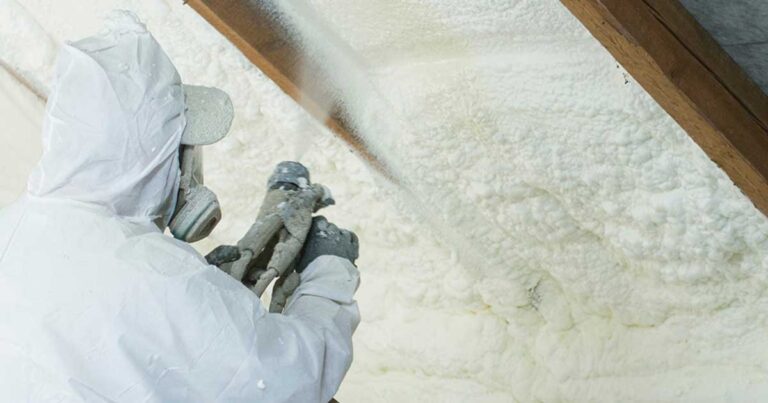
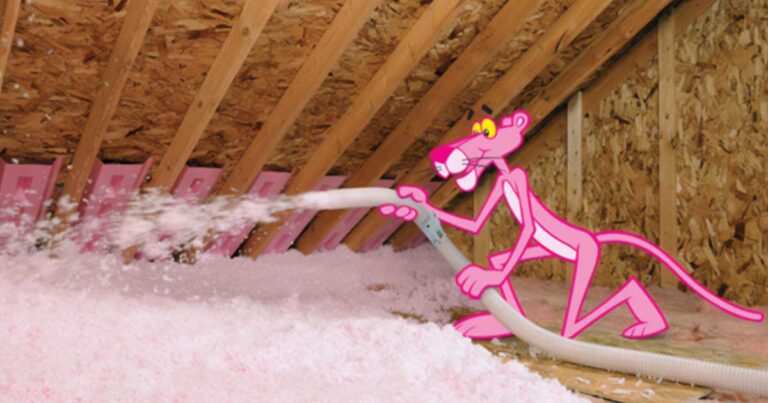
Blown-in cellulose or fiberglass, or spray foam where the assembly and access require it — common on flat-roof multifamily with hatch or bulkhead access in Brooklyn and Queens. Goal: raise roof/attic performance and cut heat loss that shows up as higher winter gas or steam use.
Above-deck and hard-to-access roofs
Where there is no usable attic, closed-cell spray foam or other above-deck approaches may be appropriate on concrete or wood decks. Access, parapets, and roof warranties constrain options; we assess on site.
Air sealing
Whole-building and targeted sealing: pipe and conduit penetrations, stair bulkheads, elevator shafts (coordination required), basement-to-first-floor transitions, and window/door perimeters where weatherization is appropriate. Air sealing is often the highest-ROI companion to insulation in leaky pre-war stock.
Rim joists, basements, and crawl spaces
Closed-cell or hybrid approaches at rim joists and below-grade transitions reduce stack-driven leakage common in brownstones and small multifamily in Carroll Gardens, Bedford-Stuyvesant, and similar blocks.
Walls and party-wall constraints
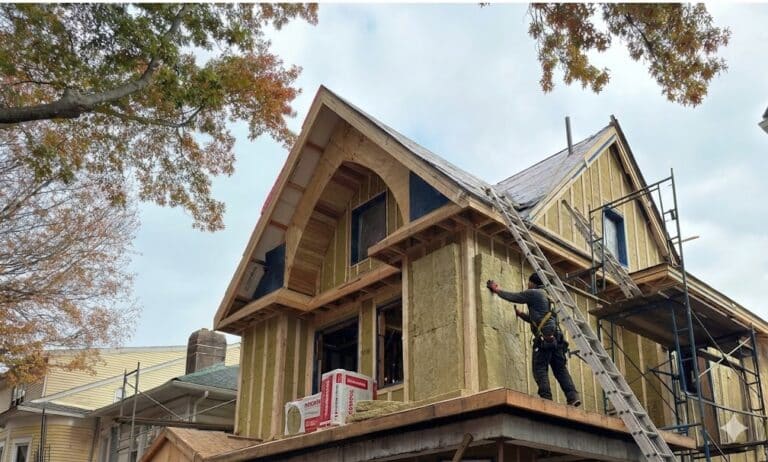
Dense-pack or drill-and-fill where cavities exist; Rockwool where fire and sound separation matter between units. Party walls and landmark constraints can limit exterior continuous insulation — we say so when a board’s preferred scope is not buildable.
Pipe and mechanical insulation (coordination)
Heating and DHW pipe insulation appears in Article 321 prescriptive measures and in good operations practice. We can coordinate insulation scopes with your mechanical contractor; primary PECM certification still follows your Article 321 pathway rules if applicable.
Related service pages: insulation services overview, spray foam insulation, blown-in insulation, air sealing, and Rockwool / soundproof insulation.
5. Stacking Con Edison, National Grid, and NYSERDA incentives
Many LL97 envelope projects can align with utility or state efficiency programs — when those programs are open and your building qualifies. Program rules, eligibility, and incentive rates change. We do not publish dollar amounts on this page.
Insulation Builders is an approved contractor path for utility weatherization work where we participate. For multifamily Con Edison pathways, see our Con Edison multifamily insulation rebate page. For National Grid residential Total Home Comfort context, see National Grid insulation rebates. NYSERDA and income-qualified programs may apply to some portfolios.
Call (347) 200-5089 to check what is currently funded for your BIN, utility, and building type before you budget incentives against a capital plan. Never assume a prior year’s rate still applies.
6. How a compliance-oriented envelope assessment works
- Intake — Address, approximate square footage, utility (Con Edison / National Grid), ownership type (co-op, condo, rental, portfolio), and whether you already file LL84/LL97.
- Document review Recent benchmarking exports, prior energy audits, roof plans, and any engineers emissions projection if you have one.
- Site walk — Roof/attic access, basement/rim joists, representative units or common corridors, moisture or ventilation red flags. Walk-up access and occupied units affect phasing.
- Scope options Envelope measures ranked by expected load impact vs. disruption and constructability not a guaranteed tonnage reduction.
- Coordination We hand scopes to your RDP or energy consultant for emissions modeling and DOB strategy.
- Install & documentation — Photos, thicknesses/R-values, and areas as needed for incentive or engineer files.
- Follow-up Revisit after a heating season when useful; LL97 is annual.
To schedule: contact Insulation Builders or call (347) 200-5089.
7. FAQ
Does Local Law 97 apply to my building? Most buildings over 25,000 gross square feet are covered, as are certain multi-building lots and condo assemblages over 50,000 square feet combined. Confirm on the DOB Covered Building List and with your counsel or RDP — exceptions and Article 321 pathways exist for some affordable and religious properties (NYC Accelerator).
What is the multifamily emissions cap for 2024–2029? For occupancy group R-2, Local Law 97 sets 0.00675 tCO2e per square foot per year for calendar years 2024 through 2029 (LL97 of 2019). Your official limit may follow DOBs property-type mapping — verify in BEAM with an RDP.
How much is the LL97 penalty per ton? For Article 320 buildings that exceed the annual emissions limit, DOB states the penalty as (actual emissions − limit) × $268 per year (DOB LL97 violations).
Will insulation alone bring my building into compliance? Not always. Envelope upgrades reduce heating and sometimes cooling load, which helps because heating and domestic hot water dominate multifamily site energy. Many buildings still need mechanical, controls, or fuel-switching measures to meet 2030 limits. We will say so when insulation is only part of the path.
When do stricter LL97 limits start? The first period is 2024–2029. Stricter statutory intensity limits apply for 2030–2034 (for R-2, 0.00407 tCO2e/sf in the statute). Further periods through 2050 are set by rule toward much lower average intensity (LL97; Accelerator).
Can we use utility rebates for LL97 envelope work? Often, if the building and measure qualify and the program is funded. Rates and rules change. Call (347) 200-5089 to check current Con Edison, National Grid, or NYSERDA options for your property.
Who should I call at Insulation Builders? Call (347) 200-5089 or use our contact page. We serve Brooklyn, Manhattan, Queens, the Bronx, Staten Island, and Long Island from 3701 Bedford Avenue, Brooklyn, NY 11229.
Closing CTA
Local Law 97 is an annual constraint, not a one-time checkbox. If your 2030 projection looks tight, start with the envelope then let your engineer size the rest.
Call (347) 200-5089 · Request an assessment
Tell us about the building
Name, Phone, Email, Property address, Building type, Message
Call (347) 200-5089